
I have been learning Welsh since 2026 February. Here is how I have been doing so:
Resources
Online Welsh Course
The main resource I have been using is the online courses provided by dysgucymraeg.cymru / learnwelsh.cymru. They offer courses in North Welsh and South Welsh, at levels:
- Mynediad / Entry / A1
- Syflaen / Foundation / A2
- Canolradd / Intermediate / B1
- Uwch / Advanced / B2
Here is how they describe each of the levels:

Textbook
There are textbooks that follow the same structure as the the online courses. You can buy them, or download them here:
Anki
Anki is a flashcard app. The thing that makes it particularly great is that it uses spaced repetition. If you don’t already know about spaced repetition, here is a fun interactive explainer about it. In short, it is the most efficient way to memorise things with flashcards. Instead of reviewing the whole pack of cards every day, you review only the cards that you are close to forgetting.
If you would rather do physical flashcards, you can do spaced repetition with them too. You can make a Leitner Box. here’s a video guide on how to do that:
and here is a pdf instruction manual.
But if you use Anki you can benefit from my labour, as I have been making sharable forms of the flashcards for all of the units as I do them, you can access them here:
- Mynediad
- Units 1-9
- Units 10-19
- Units 20-28 (not started yet)
- Syflaen (not started yet)
- Canolradd (not started yet)
- Uwch (not started yet)
Note: Anki removes decks that haven’t had many/any downloads, so if any of the links are broken contact me and I will either re-share it, or I can send it to you directly.
Dictionary
There are many dictionaries available, but this one is my favourite on account of it being easy to use and referencing other dictionaries for a more complete collection. For some reason in order to get full information on the words you need to make an account, which is weird. But it is totally usable without an account.
S4C
A TV channel of Welsh programmes. Here is the website.
BBC Sounds
BBC Sounds offers a Welsh Learning Podcast, you can listen to it here.
How I use them
Now I’ll explain my process for studying Welsh.
The Course
Primarily I follow the online courses. I like the courses because they follow a sensible structure where you learn useful words and phrases and each unit builds upon knowledge from the previous one. There is a good mixture of listening and reading and at various points the course refers you to other resources to support your learning, such as books that you should be able to read at each level. Each unit in the course follows a similar structure that looks something like this:
- Vocabulary
- Practise Vocabulary
- Conversations
- Practise patterns
- Robin Radio
- Helping Hand
- Audiobook
My process looks like this
- Click each word in the Vocabulary / Geirfa section, listen to the audio, say it out loud, and make flashcards of them.
- Click each phrase in the Practise Patterns / Ymarfer y Patrymau section, listen to the audio, say it out loud, and make flashcards of them
- Check the vocab and phrase lists in the Textbook pdf, sometimes there are additional words and phrases there. Also, sometimes the textbook explains things better.
- Study the flashcards
- (optional) Spend a few days studying the flashcards before proceeding. Sometimes I just go straight ahead immediately though.
- Listen the Conversations / Sgyrisau and the Robin Radio clip at least once, but maybe a few times. In the textbook, there are scripts for the conversations in the Textbook and questions to with engaging with the clip.
- Watch the Helping Hand / Help Llaw video
I follow that process for each unit. Not all units quite follow this structure, especially early on when they are introducing basic concepts and pronunciation, so I am more flexible than just following the steps above.
Reading
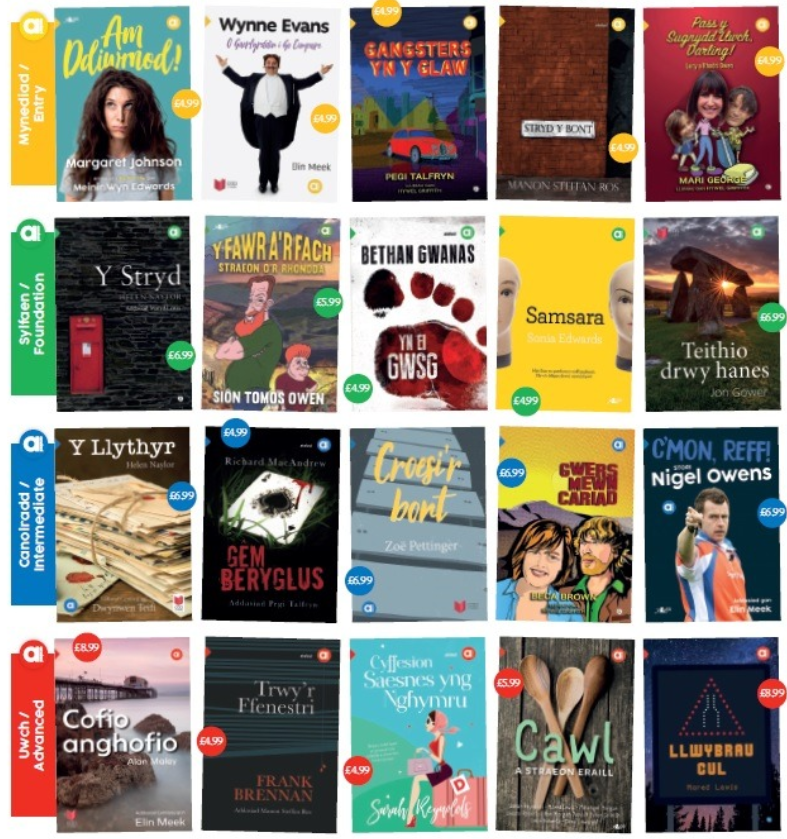
- Books
- Some units mention books that you should be able to read at that stage. Whenever this comes up, I read the book. When I read the book, I make flashcards of any new words I come across.
- I also look in charity shops and bookshops for any books that look interesting and accessible to me.
- Magazines
- Lingo Newydd
- A magazine for adult Welsh learners, which has vocabulary lists to help readers follow with potentially new words.
- WCW
- A Welsh magazine for children, it has comics, craft activities, information, news, and puzzles.
- in the back is an index which translates things into English
- Golwg
- A Welsh Language News Magazine
- Lingo Newydd
Writing
One thing I have done to support my learning is write diary entries in Welsh. I already kept a diary to help remember things and process feelings, so I just started beginning the entries in Welsh and then switching to English whenever the topics got to challenging to keep writing in Welsh. Initially I would only write a few sentences in Welsh, but by Unit 13 I could write multiple pages about what I had been up to. I don’t write an entry every day, that would be too hard to keep up and it would be demotivating whenever I failed to do it. I just write a diary entry whenever I remember.
Listening
At around Unit 15 I realised my listening skill was lagging far behind my reading, writing, and even speaking, so I decided to focus on improving it.
I started listening to “Y Podleidiad Dysgu Cymraeg” on BBC Sounds. Particularly the “Pont” episodes where they interview Welsh learners. I find that because the interviewees are learners, their Welsh is often slow and simple enough for me to understand. Mind you, I don’t understand all of it, but the more I listen the more words I can pick out and the faster I process the language.
I also started watching programmes on S4C. I watch them with Welsh subtitles to help me follow them, and so that it’s easier for me to identify and look up new words. The shows I have enjoyed so far are:
- Bliŵi – A Welsh translation of Bluey! I love Bluey in English, why not in Welsh too? I find that even with really little Welsh ability the plots are easy to follow, but the more Welsh one understands, the more funny it is as a lot of the jokes are like small spoke asides.
- Awyr Iach – A welsh children’s show about outdoor activities. It has a good variety of things and I find fairly easy to follow.
- Iaith ar Daith – A show about celebrities learning Welsh. I didn’t think I would like this but it is actually quite sweet.
I also watched Welsh content on youtube:
S4C actually has a youtube channel for Welsh Learners, with playlists dedicated to each level
- Entry / Mynediad
- It’s mostly craft videos which aren’t super entertaining but it’s really slow, clear, easy to follow language so it’s worth watching through
- Foundation / Syflaen
- Canolradd / Intermediate
- Uwch / Advanced
- There actually isn’t a playlist for this level, I guess they assume you should be able to watch basically anything at this level?
- Sketchy Welsh
- Weird and fun videos. One could totally make flashcards from them.
- This guy also makes books, so that’s cool.
- And he appeared on an episode of the BBC Sounds podcast
- Dysgu Cymraeg Playlist
- A playlist by S4C of videos for learning welsh. I enjoyed the comedy series in here.
Conversation
Finally, the other thing I do is talk to people in welsh. I am fortunate to know Welsh speakers that are happy to help me learn. Some ways I have done or might do this is:
- Give them a list of questions to ask me based on what I have recently learned.
- Do little activities in Welsh such as going on a Welsh speaking shopping trip.
- Asking them to help me read Welsh when we see it out and about in Wales.
- Asking them to help me with pronunciation.
- Saying “Ti’n iawn?” (“You alright?) to initiate a Welsh language conversation. I do this in person, in calls, and over text.
- Having Welsh language calls.
Leave a Reply